Sunday, 19 February 2012

Rainbow Trail

Walk on a rainbow trail; walk on a trail of song, and all about you will be beauty. There is a way out of every dark mist, over a rainbow trail.
- A Navajo Blessing

Double Rainbows at Boya Lake Provincial Park on the Stewart Cassiar Highway in B.C.

Thursday, 9 February 2012

Raven Antics

My ravens don't do antics. They don't slide or roll down snow-covered roofs or hills as reported elsewhere in news stories. Instead, they land in the driveway or under the feeders and pig out on sunflower seed. At one time, I counted 24 of the big birds in the driveway. But, I have trained them. When they see me moving at the big living room window or opening the front door, they know to leave. Of course, they're back within minutes. One day, when I was in the back yard putting out seed in the feeders, a group of 18 or so, flew lower in the sky as they passed by, and when they saw me, they continued on to bother the dogs down the road. If the ravens can't eat seed, they'll eat dog food.

They are smart survivors. Leave any garbage out, and within seconds, the black birds have found it. We've all seen instances of pick-ups parked at the grocery store, and ravens tearing open boxes and bags to get at food. Happened to us, but not from our vehicle, but from a boat. My husband and I, with some friends, were boating down the Yukon River from Dawson City to Ft. Yukon when we landed outside of Eagle, Alaska and walked into town. No ravens were around; never gave a thought about the cardboard boxes in the boats that contained groceries. When we returned to the boats, at first we were puzzled at seeing the top of the boxes torn, but, when we discovered a bread bag missing, we knew who the culprits were. The robbers had disappeared to eat their prize.

Ravens are fun to watch. In Whitehorse, there are clay cliffs bordering the town along the river, and ravens are always riding the thermals. In cold temperatures, they fluff out their leg feathers as they walk in the driveway. A raven will also fluff out its neck and throat feathers when annoyed at another raven. I've watched ravens using their big beaks to dig through sea weed or pick up sea urchins. And they are beautiful birds. When the sunlight shines on their feathers, the solid black becomes iridescent purples and blues; the feathers layered in intricate patterns.

I have seen one antic, and not with my driveway ravens. When driving this winter past a parking lot, I spotted two ravens on the ground. One lay sideways; the second one sat close by poking at a black rope or wire that the first raven lay on. When the bird stood up, the wire/rope stayed under its feet. Were its feet caught in the wire/rope?  I stopped and watched. The second raven tugged again at the wire/rope; the first raven lay back down and rolled around while holding onto an end of the wire/rope. The second raven flew away, and the first raven stood up triumphantly holding a stiff wire in its beak. It flew off with its prize.

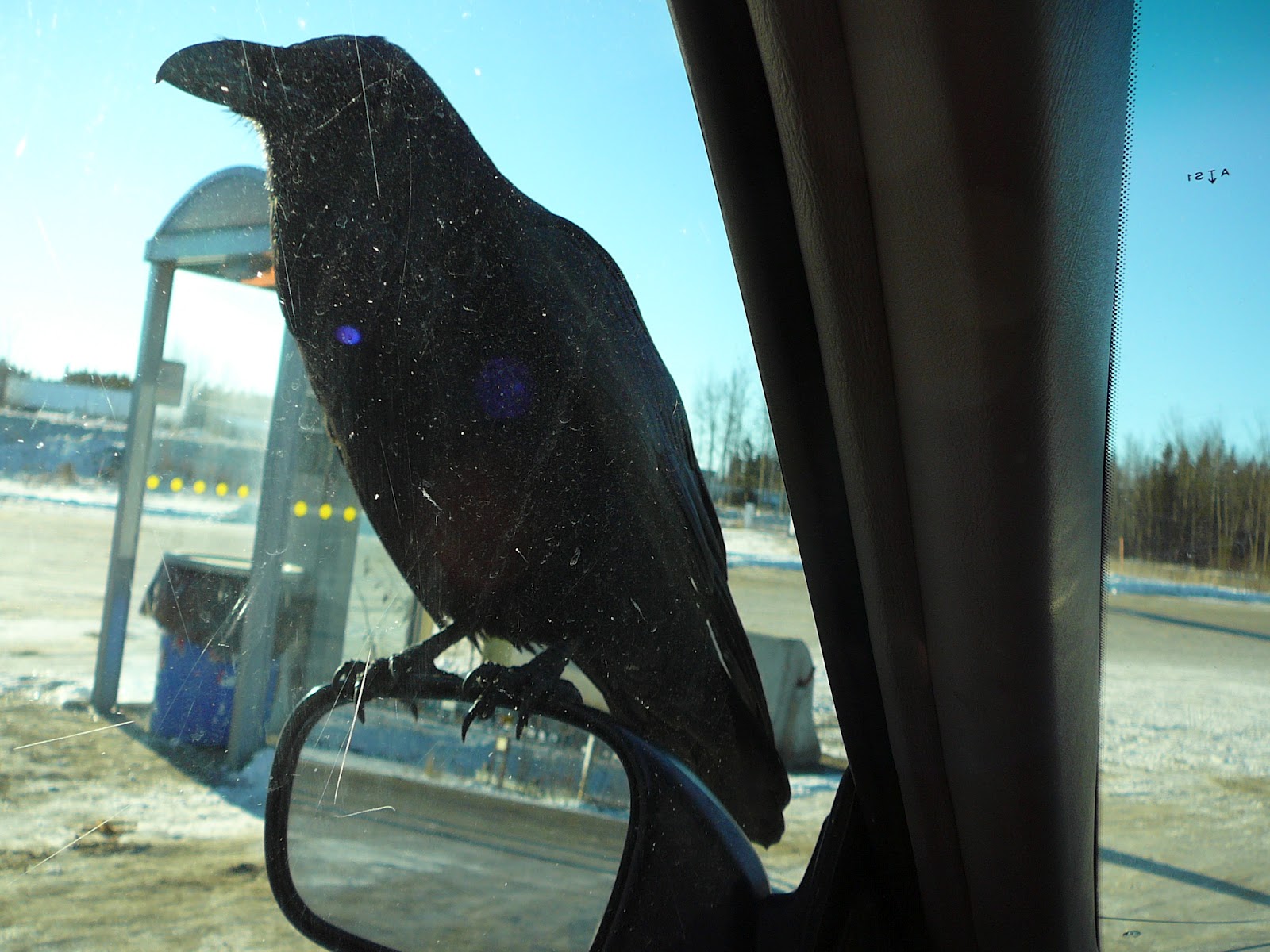
There is one behavior that ravens do in Watson Lake that I've never seen anywhere else. They ride on vehicles! If someone is parked at the gas station or grocery store, there's a good chance that the raven sitting on the hood of their vehicle will hitch a ride. Like a hood ornament, the bird sits still and faces into the wind as the vehicle travels. After a few hundred yards, the raven flies away.

In the North, the Common Raven will always be part of our lives.


Saturday, 28 January 2012

Surviving the Cold

-47C!  Brr! Put more wood on the fire and keep close to the heat!

I think of the poor birds so cold outside, yet when I pull back the curtains at 9 a.m., when there's enough light to see something in the yard, there's a great deal of bird activity at my feeders. Common Red Polls in the driveway, on the shoveled snow mounds around the feeders, in the trees - busy eating the high protein black-oiled sunflower seeds.  A Downy Woodpecker clings to the log suet feeder pecking at the peanut butter suet mix; a Hairy Woodpecker climbs up the poplar tree trunk. A few Pine Grosbeaks mingle with the Red Polls at the feeders; most sit on the tree branches shivering to increase their metabolic rate to warm up.  All the birds are speckled with frost.

In this extreme cold, I don't see the Chickadees feeding in the morning. Either they've already eaten and will return near sunset or they are still snuggled together with their lowered temperatures in a cozy place. I won't see the Gray Jays until the temperature rises.

Cold days mean blue skies and intense sunshine. Between feeding, the birds sit high in the treetops where the sun rays reach. Their bodies are round balls with feathers fluffed to trap air creating insulating layers.  As the Red Polls hop around the driveway feeding on seeds, their legs are hidden by the feathers, and it looks like they're hopping just on their fat bellies.

Then, the ravens come. They settle on the ground in the driveway and under some of the feeders. The smaller birds fly up to the tree branches or move to other feeders. Today, the ravens have frosted white caps and cheeks, and as they move around, their 'pants' are fluffed to keep their legs warmer.  As I move in the window, the ravens fly off to find another source of food, and the other birds return to the feeders.

I put on my thick snow pants, parka, toque, neck warmer, mitts and big boots, fill up a bucket with seed and venture into the cold. My breath floats as a cloud before me; my boots scrunch on the dry snow. The birds fly into the trees and wait for me to fill the feeders and throw some on the ground. I return to the warmth of my woodstove and watch the busy birds through the window. What better thing to do on such a cold day?


Thursday, 5 January 2012

Happy New Year

When the New Year arrived many greetings were exchanged through emails, Facebook, Flickr, blogs and forums that I participate in. People were posting quotes meant to encourage others to think positively, follow their dreams, help others, etc.. There were links to motivational sites. The majority of folks that I communicate with, I've never met face-to-face, don't even know what they look like, and for the most part, only snippets of their lives, given in posts about a bird, hiking, traveling, a hobby, are known to me. This is probably the case with the majority of folks who participate in on-line communication. Yet, we consider our fellow communicators as Friends as soon as we 'meet' them.

I joined Facebook a year ago, mainly to see photos posted by my daughter and relatives, and I've been surprised that all comments in Facebook that I read are very encouraging. The Like button also makes it easy to give fast positive feedback. In forums, as soon as a new person joins everyone is welcoming and continue to give positive thoughts to all posts. In Flickr, many comments about photos are single words - people taking time to send off an encouraging word. Blogs have buttons readers can click to give feedback. I rarely see a negative comment in these communication sites. If there is one, it's part of a chat when opinions are shared.

The news is filled with doom and gloom. Individuals are feeling the weight of money issues, family and personal problems. There are those who are concerned about adults and youth who are continually communicating through instant messaging. There are those who are concerned about society losing face-to-face communication. But if people are communicating often in an atmosphere of sharing, encouragement and support, wouldn't positive thoughts and actions become the norm in everyday life?

And if this is happening worldwide across cultures and races?

So, in this new year, I sent out a positive quote to my Friends.

"Use what talent you possess, the woods would be very silent if no birds sang except those that sang best."
Henry Van Dyke

Happy New Year

Winter Sunrise over Wye Lake,  Watson Lake, YT

Tuesday, 27 December 2011

Winter Day

Yesterday I went x-country skiing. Fresh snow had fallen the day before on old hard-packed snow, and I was eager to ski on the snowmobile trails through the forest. The sun was bright, the sky an intense blue, and the temperature only -2C - quite warm for this time of year. The trail I choose was packed by a snowmobile, yet the snow was soft and as I skimmed along, it whispered beneath my skis.

Fresh wolf tracks were pressed into the snowmobile tracks, and I followed them as the trail descended gradually, twisting through the forest. In three minutes I was past the last turn and onto flat ground and soon reached a large abandoned gravel pit.

I was a half mile from the Alaska Highway and the centre of Watson Lake town, but the only sounds I heard were from my skis and surroundings. The wind shook bushy tops of spruce and pine and snow cascaded down the trees. Two gray jays fluttered across the sky. A pine grosbeak called from the forest. Ravens flew on their air path from the garbage dump to the sewage lagoon, and at times circled downward to check on this creature on the trail.

The gravel pit opened up before me and snowmobile tracks led off in numerous directions. Do I ski an hour longer down to the Liard River? Do I go upward on a snow covered road to circle back to my pickup? Or do I continue through the gravel pit where the wolf had gone? I follow the wolf tracks.

Other animals had left signs of passage. Snow hare prints were in the soft snow and disappeared into willows and brush. Tiny paw prints stopped where long feather marks were spread out on each side of the snowmobile tracks.  An owl had found a meal.

The open gravel pit allowed me a wide view of the sky and landscape. Clouds floated lazily through the blue expanse, often changing shape from elongated pools to swirls and spirals created by a master artist on a canvas. Sun rays dressed poplar and birch trees and spread as fingers across snow covered side hills.

As the sun lowered, the sky and clouds turned purple, rose and deep orange. Time to leave the wolf tracks and return to my pick up. A squeaky chirp from the forest stopped me and I 'cheed cheed' back to the boreal chickadee. It chirped back. We continued the conversation until the wind shook the trees and the bird flew away.

When people ask me how I deal with northern winter cold and darkness, I smile and remember a day such as this, and reply, "Oh, I survive."


Tuesday, 6 December 2011

Boss Squirrel

I have holes and tunnels in my yard. Mind you, there's two feet of snow on the ground, and the holes and tunnels are in the snow, made by the Boss Squirrel of the front yard.  When I watch the birds at the feeders, there is Boss Squirrel with his head poking above the snow for a look around. His head disappears and seconds later, he reappears farther down the lawn. He rushes to the trees and runs up the branches - here and there - chasing the birds from the trees and feeders. More birds are arriving every day, more birds spread out in 10 trees, but Boss Squirrel is persistent.

Even the large Common Ravens don't escape Boss Squirrel's wrath. As they feed on the fallen sunflower seeds, they hop into the air to escape this crazy creature running amok in their midst and escaping into the brush or up a tree. From the tree, Boss Squirrel will jump down into the flock of ravens, making them scatter. Eventually, the ravens leave to eat in quieter surroundings such as the garbage dump or grocery store parking lot.

Boss Squirrel has a difficult life. On the house roof,  I blocked the narrow space between two roof lines where Boss Squirrel was squeezing through to cache his pine cones.  Our truck repair centre cleaned out his huge nest that he had built behind the glove compartment by crawling through the truck engine. I took away the small towel that he had pulled out from under the garage door (that was filling a space caused by ground imbalance) and was tearing apart for bedding. Some of his holes in the snowbanks along the driveway were covered when I shoveled snow. Once, he barely escaped me stepping on him when I stepped off the snow path through the lawn. His squeak and rapid movement warned me to tread carefully.

There's Boss Squirrel now, eating on the sunflower seeds that I scattered far down the driveway. Closer to the house, also eating on sunflower seeds, are two juncos and a common red poll. Oh, no - Boss Squirrel sees them and he's charging over twenty feet to scatter the birds. He settles down to eat the seed, content that he's the boss of the front yard.

Wednesday, 17 August 2011

Birdwatching

I love birdwatching. It's a new hobby developed since I retired and moved to our current house in April 2007.  The first winter, I threw out some black oil sunflower seeds and before I knew it I had these robin size birds with red on their heads and chests (Pine Grosbeaks), and smaller birds with red tops and pinkish red streaks on their breasts (Common Redpolls). Then the black cap chickadees and gray jays arrived. That was easy.

Once I knew my winter birds I moved onto the sparrows in the spring. As numerous birds hopped around the yard, I frantically scribbled notes and took photos.  But that yellow bird flittering through the trees wasn't in the sparrow section of my bird guide. Finally found it - in the warbler section. Time to learn about warblers. There are so many pages showing warblers....

Fortunately, there is a bird observatory station in my town and each spring and fall the station nets and bands birds. I volunteered to help and I learned how to take the birds out of the nets without injuring them. I could actually hold the bird and feel the softness and warmth of its body and its tiny heart beating in its chest.

Now my seasons are marked by the bird migration. Spring starts April 23 when the station opens and the nets are put up to band for the spring migration. We may be walking with snowshoes on two feet of frozen snow around the nets, but by golly, it is spring! The pond at the station is still covered by ice, but it's spring!

The bird station opened on July 23 for the fall migration. In my garden, the vegetables are still growing, the tomatoes are green, and many flowers haven't blossomed, but the fall migration has started!  Time to band the parents and juveniles moving south. Birds arrive in my yard with their juveniles and the air is filled with the constant chirping of young wanting to be fed . The pine siskins are flocking in larger groups and invading birch trees to dangle from the catkins as they eat the seed. Waterfowl are arriving on the small lake nearby to rest and feed on their journey south. Birds are moulting and ravens fly overhead missing feathers on their wings and tail.

Bird watching has made me observe nature more closely: the tiny flies that hover around leaves where the ruby crowned kinglet catches and eats them; the tiny squeak that tells me I've surprised a boreal chickadee in the trees; a rustling sound in the brush where a fox sparrow is hopping and pushing leaves with its toes as it lands. Bird watching makes me stop, listen, watch, relax and feel nature.

May we all have a hobby that gives us well-being.

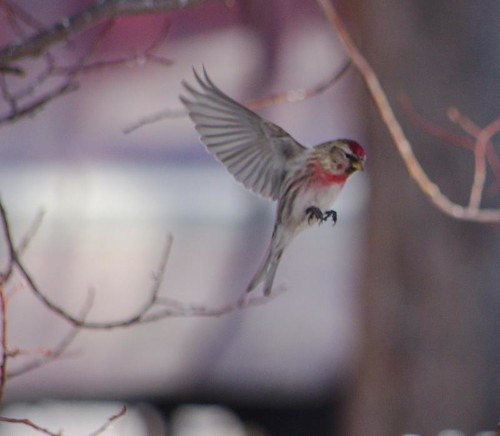
Common Redpoll landing